Abuse of Authority / Censorship / China / Lawfare / Moon Jae-in / Rule of Law / Translation of Korean News
South Korea’s National Election Commission’s Dereliction of Duty Constitutes Treason and the Jamsil Suffrage Struggle Is a Second Korean War
2026-7-10, Op-Ed (English and Korean): Lee In-ho
Note: Professor Emeritus Lee In-ho served as the Republic of Korea (ROK) Ambassador to Russia and Finland. She also taught history at Korea University and Seoul National University and served as the Chairwoman, KBS Board of Directors.
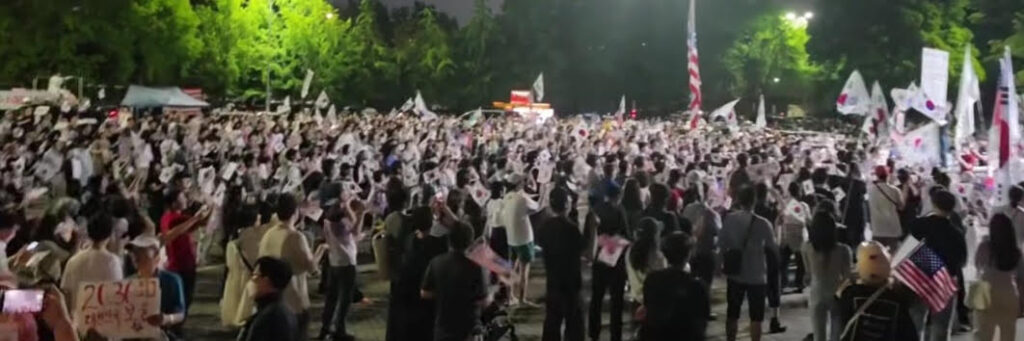
Photo above: People rally at the Olympic Park, Seoul, 2026-6-21 (continuously ongoing 24/7 since 2026-6-5 to present), chanting: “Election Fraud, Re-vote, One Day Voting, Same Day Hand Count”
The Essence of the Jamsil Protest
The protests taking place at the Olympic Park in Jamsil neighborhood, Seoul, South Korea, in defense of the right to vote were triggered by the absurd incident of a shortage of ballots. [Note: During the nation-wide local elections on June 3, 2026, one of numerous irregularities was ballot shortages in 91 precincts across South Korea, resulting in many registered voters unable to vote. The National Election Commission (NEC) decided to deliver only 50% of the ballots to certain precincts, especially in areas with more conservative voters.]
But the matter cannot end with the resignation of the current leadership of the National Election Commission (NEC) or the re-holding of the June 3rd elections. The suspicions of electoral fraud that have been accumulating among awakened citizens for over twenty years, the unresolved discontent with the NEC’s approach to election administration, and concerns about the future of the Republic of Korea as a democratic republic have at last begun to erupt as popular rage. The realization that the NEC’s repeated “mistakes” over the past two decades were likely facets of deliberate fraud—and the demand for accountability—has now begun.
Forces across the political spectrum—the ruling party, the opposition, the media, and the general electorate—those anxious not to lose even a sliver of their vested interests regardless of where the country ends up, have long turned a blind eye to blatant violations of electoral law laid bare before them. Yet the younger generation in their 20s and 30s—still possessed of clear souls and sharp intellects who know they cannot live without the air of freedom—have sensed in their bones that their fundamental rights as citizens are being trampled and their futures as members of a democratic state are being blocked, and have stepped forward at the forefront of vigorous protest. It is worth noting that beneath their courageous actions lie a deep undercurrent of disappointment and distrust toward the establishment as a whole—the ruling and opposition parties, the media, and the business world alike—all of whom rush to protect their vested interests in the face of injustice.
The resignation of the current NEC leadership or the re-holding of the local elections does not constitute a definitive solution. Based on facts already made public, suspicions of fraud large and small surround not only this June 3rd local elections, but virtually all elections held in past years. In the harsh reality of international politics, no vacuum in state governance can be permitted; it is a lamentable reality that we must resort to stopgap measures that acknowledge the need to compromise with political forces that seem indifferent to the “formal” legitimacy of those in power or to the welfare of the people. But without a thorough investigation and strict accountability for those who have effectively run the NEC over the past 20 plus years, a re-election is both impossible and meaningless. Replacing a few members of the current leadership will serve only as a means to minimally placate the public discontent with gross election integrity failures while concealing vital evidence of criminal activity—it will not amount to victory for the movement to defend the right to vote, nor a genuine restoration of sovereignty for all the people of the Republic of Korea.
Evidence of the NEC’s Repeated Violations of Law and Intent to Engineer Fraud
The struggle for fair elections is not a task unique to us. History across all times and places shows no exception to the temptation of fraud, great or small, in elections. But in the past twenty-five years, there has been no precedent like that in the Republic of Korea, where the NEC has so openly violated electoral law and election results have been distorted yet tolerated—at least not in a country that claims to be a democracy.
The Republic of Korea’s NEC is a powerful institution established by the Constitution to guarantee that elections—the cornerstone of democratic governance—are conducted fairly and efficiently. But there has been far too many grounds for suspicion as to whether the true goal of those who have effectively monopolized the running of the NEC, expanding and restructuring it, was genuinely fair elections—or rather the expansion of room for fraud to seep in. The very attitude of dismissing citizens’ suspicions about electoral deficiencies and the possibility of fraud—and of labeling even proposals for stronger oversight or systemic reform as “conspiracy theories about rigged elections”—rather than humbly receiving them with surprise and sincerely investigating and responding, was itself a symptom that the NEC’s interest lay elsewhere, not in securing the fairness of elections. Because neither the political world, nor the media, nor the majority of voters resisted this strongly and let it pass, we now find ourselves paying an even harsher price—conducting hunger strikes amid sweltering heat and torrential rain—and standing at a crossroads where we may lose.
Direct testimony has also emerged, as the former chair of the NEC’s labor union laid out in eight categories a detailed exposé of the agency’s history of legal violations. Even without such insider whistleblowing, there was ample evidence that the NEC’s intent was to widen the room for fraud to enter.
First, the NEC replaced the internationally recognized procedure for blocking the insertion of fraudulent ballots—the manual stamping of each ballot by election officials with their own seals— with stamps already pre-printed on the ballots. This is a procedure that cannot be perfectly replaced by barcodes or serial numbers, and it is the system that guarantees the credibility of recounts. Moreover, it requires less money and organization to implement, yet in defiance of citizens’ demands to restore this safeguard, what was done only for the relatively new procedure of early voting [printing the stamps on the ballots as each early ballot is printed from a printer on site—which also disregards the safeguarding purpose] was extended to election-day voting as well this time. Why?
Second, the NEC disregarded the principle prohibiting the breaking of ballot box security seals. The NEC used defective seals that do not leave any trace when removed, which defeats the purpose of preventing tampering. In addition, the early vote ballot boxes in storage were accessed, seals removed to add extra ballots, and then resealed—all recorded on CC cameras in the storage rooms.
Cases of transferring ballots to counting centers via post offices—or even carrying them in bread boxes or wicker baskets—passed without meaningful correction or punishment. Making the early voting period longer than election day and adding several days of storage of early voted ballots can also be seen as methods of increasing the possibility of fraudulent interference. Citizens with a genuine interest in the affairs of the nation and who wish to exercise their sovereignty through the vote would have participated in the election even without an extended early voting period.
Third, the events that unfolded after the introduction of electronic vote-counting machines based on China’s Huawei system—already a subject of security-level vigilance in the United States and elsewhere—appear to belong to a category of international large-scale crime that cannot be adequately discussed in this space. The consistently observed gap at a certain ratio between election-day and early voting results was enough to raise doubts even for those who are not statisticians or computer experts. What confirms the possibility that this was not a natural phenomenon but the result of manipulation is the fact that the NEC continuously resisted or dismissed the requests of the President [Yoon] and the National Intelligence Service to verify the possibility of external penetration of the NEC’s servers.
This was also the fuse that led President Yoon Suk-yeol to declare that ill-fated martial law on December 3, 2024. When the President, having been briefed that even a limited partial inspection confirmed that the possibility of external penetration was open, demanded a thorough full inspection, the NEC resisted, citing its status as an independent “constitutional body.” During proceedings at the Constitutional Court regarding President Yoon’s case, the NEC offered the response: “Our server is an absolutely impenetrable system, but since the NIS said it would conduct an inspection, we deliberately left it open.” This was a condescending statement that assumes the people are unthinking and that they would actually believe the NEC servers, which North Korea hacked, are impenetrable.
This was an admission that the NEC had directly sabotaged the President’s attempts to verify that elections were being administered fairly—yet the Constitutional Court, politicians, journalists, and ordinary voters all passed by indifferently. The unbridled arrogance of the NEC and its backers, who had become confident that they could freely manipulate our voting results, has now manifested in this comical yet fatal operational blunder of a shortage of ballots.
Fourth, regarding the NEC’s lax management, overreach, and nepotism, there is already more than enough material made public in the media. The NEC, which received massive budgetary support with the expectation that it would uphold the backbone of democracy and maximize the national interest through fair and efficient election administration, went in precisely the opposite direction. More than one or two traces have appeared that raise suspicion that the NEC—being neither an elected nor a professional body—unnecessarily involved itself not only in observing foreign election systems but even in the introduction of election equipment, earning the country a bad reputation that the equipment South Korea exported was the cause of fraudulent elections, and that the NEC was engaged in treasonous acts that opened a wider path for foreign hostile forces to penetrate our elections. Looking at the recently published book The Dandong Project, co-authored by Kim Mi-young and Roy Kim, the NEC’s criminal misconduct appears to have reached the level of an international criminal cartel, not confined to the domestic sphere. The content of The Dandong Project has credibility because it is based on events that were already widely reported in the international community, even if blocked domestically by a corrupted media.
If there is a genuine intention to build and operate a fair electoral system that admits absolutely no room for fraud, there is no shortage of methods for future electoral reform—and at least on the surface, there will be no one in any party or sector, political or otherwise, who would disagree with that goal. Technologies abound for making the voting and counting process transparent and efficient while protecting individual privacy, and the Republic of Korea is not a country lacking the technology or economic capacity to build such a system. From the very beginning, whether or not there exists the intention and will to establish a flawlessly fair electoral system has been the key question.
The people of the Republic of Korea must now face a harsh reality. Today’s Korea is not the Republic of Korea of the early new millennium, when the Soviet Union and the communist bloc in Europe were collapsing—nor even the country that, until just recently, was acknowledged by all, including itself, to have achieved success in both economic development and democratization. We must realize that we are not a normal country in normal times; we are a people continuously under infiltration and attack from enemies within and without. The struggle of young people that began in Jamsil is not merely a fight to secure the right to vote—it is a struggle on which the survival of the Republic of Korea as a free democratic republic depends. Further, it signifies that the struggle—always ongoing, visibly or invisibly, between those who strive to build a world where human conscience and dignity are upheld through the rule of law and democratic institutions, and those who stop at nothing to gain power—has now reached a desperate crossroads where humanity could be socially suffocated. In the context of the shifting balance of global power: if the liberation of 1945, the founding of the Republic of Korea in 1948, and the Korean War represented an experience in which the Korean Peninsula became a frontline in the Cold War between the communist and free worlds, between the Soviet Union and the United States, and our entire nation suffered great sacrifice while South Korea alone [not the entire Korean Peninsula] survived as a democratic state—then the destructive campaign against us that has proceeded in a far more sinister manner behind the façade of “democratization” can be seen as a second Korean War in which we have once again become a frontline in the fierce competition between the United States and China, and as a struggle for the protection and second founding of the Republic of Korea as a free democratic republic.
The current tide of battle is unfavorable to pro-Republic of Korea (ROK) forces. While the established elite of South Korea as a whole have not even sensed that the ground beneath their feet is giving way, underground forces—a combination of socialist true believers hiding behind seductive slogans, pro-North Korea / pro-China / anti-ROK elements, and large criminal organizations—have mobilized their specialty of propaganda and agitation, seized even the extraordinary means of monopolizing the operation of the ROK’s NEC, and have already seized the political high ground and major media outlets. Much of the media and the so-called social leadership class, having surrendered their souls to opportunism, have become easy targets of China’s “Unrestricted Warfare” (hybrid war) and have sold their conscience and human rights—leaving ordinary citizens, desperately short of information, unaware of what is happening, and having the entire country stolen from right under their noses. We have lost the capital and are now standing at the frontline of the Busan Perimeter.
But we have an awakening younger generation, and unlike North Korea, we have a homeland worth protecting. Some of the former activists who once called themselves “progressive” have degenerated into an ugly vested-interest class and attempt to suppress the future leaders of this nation—those with living consciences and discernment—by calling them “right-wing diehards,” but this suppression of the younger generation will fail. Our youths—in their 10s, 20s, and 30s—have the vision and courage to recognize and resist the fact that no topic in history or politics should be beyond question, and that for a state or National Assembly to legally sanctify a particular historical event as untouchable is something that can only happen in the most extreme dictatorships. [Note: “A particular historical event” refers to the Gwangju incident of May 1980.]
Furthermore, can there exist in the world a “sacred zone” where the names of the “saints” (the “5.18 Meritorious Persons”) are kept secret while they receive real preferential treatment, as in the case of the Gwangju incident on May 18, 1980?
Without declaring ourselves a colony of that country, can we grant voting rights and various special privileges—not given even to the majority of our own citizens—to foreign nationals (Chinese citizens)? How low must China—having supported North Korea in the Korean War, fighting against us, and thwarting the near-complete northward unification—think of us to display in the Republic of Korea the Chinese Communist forces’ slogan “Resist America, Aid Korea,” and to plan educational programs at our War Memorial—whose very reason for existence is to honor our fallen war heroes—that propagandize the meaning of that unspeakable slogan?
No person with a conscience can fail to feel that we are not a “normal country” right now, and that the National Assembly is instead leading the nation down a path of self-destruction. Can it be a phenomenon that could occur without the NEC’s illegal cooperation—five people with absolutely no political experience were elected as National Assembly members, because all of them were defense attorneys for an incumbent president [Lee Jae-myung] who is a convicted felon and criminal suspect; and indicted law violators sit in judgment of judges and prosecutors under a “National Assembly’s” one-party dictatorship? This is a question anyone with trust in the political judgment of voters in the free democratic Republic of Korea—which has grown over eighty years—and capable of sober rational thinking, can ask.
To be bound by the formality of “legal procedure” and turn away from political truths felt in the heart and recognized in the mind is something only corrupt vested-interest forces do. We must now throw off the national folly of allowing anti-ROK forces to take up key state positions such as National Assembly seats through elections, and immediately put the brakes on the process of the country being seized by hostile forces from within and without. As it has become known—through YouTube and other channels even amid the paralysis of the mainstream media—that all those who participated in the past democratization movement with pure hearts have begun to fight against forces that have insidiously transformed into vicious vested-interest groups and are destroying the Republic of Korea from within, the dictatorial governing party retaliated by passing an amendment to the nation’s information and network law [a free speech suppression law] which just went into effect on July 7, 2026. Any media, including social media platforms, which carried information, judged false and manipulated by the government standard, is now liable to fines up to 1 billion won (~$675,000).
The ballot shortage incident that has now erupted is a case in which the long tail of the NEC’s treasonous conduct, carried out for over twenty years, has been caught—and the tip of the iceberg of treason has been exposed. Investigating and demanding accountability for the June 3, 2026 election and the NEC cannot be accomplished simply by referring the matter to a parliamentary investigation or special prosecutor. Young people who have risen voluntarily to defend the right to vote—a fundamental right of citizens—must themselves take up the work of digging into the NEC’s past conduct. The popular struggle must not stop until those involved with the NEC who have committed great crimes against the state and against human rights have been punished with penalties commensurate with an attempted overthrow of the state. This is not a matter to be divided along partisan, left-right, or regional lines—it is a struggle that no one who wishes to live as a free human being can refuse, and if necessary, we must not hesitate to seek the assistance of international solidarity. We must also bear firmly in mind that the dissolution of the existing NEC or partial re-elections are means to prevent the detonator of corruption from exploding and to conceal criminal evidence—they are not a victory for the movement to defend the right to vote and rebuild the Republic of Korea.
Lee In-ho, Professor Emeritus, Seoul National University, July 10, 2026
—–
[선관위의 배임은 반역의 차원이고 잠실의 선거권 투쟁은 제2의 6.25 전쟁이다]
잠실 시위의 본질
투표권 수호를 위해 잠실에서 벌어지고 있는 항의 시위는 표용지 부족이라는 어이없는 사건에서 촉발되었다. 하지만 선관위 현 집행부의 사퇴나 6.3선거 재실시로 끝날 일이 아니다. 깨어있는 국민들 사이에서 20년 넘게 쌓여 왔던 선거 부정 의혹과 선관위의 선거 관리 자세에 대한 해소되지 않는 불만과 민주공화국 대한민국의 미래에 대한 우려가 국민적 분노로 드디어 폭발하기 시작한 것이다. 지난 20여년간 거듭되어온 선관위의 ‘실수’들이 의도된 부정의 일면이었을 가능성이 높다는 각성과 그에 따른 책임추궁이 시작된 것이다.
야, 정치권, 언론계, 일반 유권자층 가릴 것 없이 나라야 어찌되든 자그만한 기득권이라도 놓칠세라 조바심하는 세력들은 눈앞에 환히 드러난 선거법 위반 사례들을 외면해 왔다. 하지만 아직 영혼이 맑고 지적으로 영민하여 자유라는 공기 없이는 못 사는 줄 아는 우리 대한민국의 20~30대 젊은 세대는 자기들의 국민적 기본권이 유린당하고 민주 국가 시민으로서의 앞날이 막히고 있음을 몸으로 감지하며 바로 강력한 항의에 앞장섰다.섰다. 그들의 용기있는 행동 저변에는 불의 앞에서 기득권부터 챙기는 여야 정치권, 언론계, 경제계 할 것 없이 기성 세대 전반에 대한 실망과 불신이 짙게 깔려 있음을 주목할 필요가 있다.
현 선관위 운영진의 사퇴나 6.3 선거 재실시는 확실한 해결책이 되지 못한다. 지금까지 공개된 사실만으로도 크고 작은 부정 의혹에 휩싸인 것은 이번 6.3 지선뿐 아니라 지난 날의 선거 거의 전부다. 엄중한 국제정치 현실 속에서 어떤 국정 공백도 허용될 수 없기 때문에 현 권력층의 ‘형식적’ 합법성이나 국민의 안위에는 관심조차 없는듯한 정치세력들과의 타협 필요성은 인정하는 미봉책을 쓰지 않을 수 없는 우리 대한민국의 참담한 현실이다. 하지만 지난 20여 년간 선관위를 실질적으로 운영해온 자들에 대한 철저한 조사와 엄중한 문책이 없이는 재선거는 불가능하고 무의미하다. 현 집행부 몇 명을 교체하는 것은 비리의 뇌관이 터지는 것을 막고 범죄 증거를 은폐하는 수단이 될 뿐, 선거권 수호운동의 승리, 정치꾼 들이 아니라 대한민국 국민 전체의 진정한 주권회복은 못 될 것이다.
선관위의 거듭된 법위반과 부정획책 의도의 증거들
공명 선거를 위한 투쟁은 우리만의 과제가 아니다. 선거가 항상 크고 작은 부정의 유혹에 흔들리는 데는 역사적으로 동서고금 예외가 없었다. 하지만 지난 25년간 대한민국에서처럼 공공연하게 선관위가 선거법을 위반하고 투표 결과가 왜곡되어도 묵인되어 온 사례는 적어도 민주주의를 표방하는 나라에서는 없었다.
대한민국 선관위는 민주주의 체제의 핵심인 선거의 공명정대하고 민활함을 보장하기 위해 헌법으로 설치된 막강한 기관이다, 하지만 그 기구를 확대 개편하며 실질적으로 독점 운영해온 사람들의 목표가 과연 공명 선거에 있었는지 아니면 부정이 스며들 수 있는 여지를 확대해 가는 데 있었지에 대해서는 의혹이 갈 근거가 너무도 많았다. 선거 부실과 부정 가능성에 대한 시민들의 의혹 제기를 깜짝 놀라 겸허하게 받아들이며 성실하게 조사하며 답변하는 대신 감시 강화나 제도 개선 제의까지도 ‘부정선거 음모론’으로 몰아붙이는 태도 자체가 바로 선관위의 관심이 선거의 공명성 확보가 아니라 다른데 있었다는 증후 아니었던가. 정치권도 언론계도 유권자 대다수도 그것에 강하게 항거하지 못하고 지나쳤기 때문에 우리는 지금 폭염과 폭우 속에서 단식투쟁까지 해야 하는 더 혹독한 대가를 치르며 패배할 지도 모를 갈림길에 있는 것이다.
선관위 전 노조위원장이 8개 항목으로 정리하여 조목조목 폭로한 역대 선관위의 범법 사례에 대한 직접적 증언도 나왔다. 그런 내부자 고발이 없었더라도 선관위의 의도가 부정이 끼어들 여지를 넓혀가는 것이었음을 알 수 있는 증거는 충분했다.
첫 번째로 선관위는 부정투표지의 투입을 원천 차단하는 세계공인 절차인 선거관리인 손도장 찍기를 사전 인쇄로 대신했다. 바코드나 일련번호로도 완벽하게 대체 할 수 없는 절차이고 재검표의 신빙성를 보장하는 제도이다. 더구나 돈이나 조직도 덜 드는 일인데 그 장치를 부활시키라는 국민의 요구를 거슬러 사전 투표에서만 하던 짓을 이번에는 당일 투표에서도 했다. 무엇때문인었나?
두 번째는 투표함 봉인 훼손 금지 원칙을 무시했다는 점이다. 우체국을 통해 투표지를 개표장으로 이관하거나 심지어는 삼립빵 상자나 소쿠리에 담는 사례까지 나와도 별 시정이나 처벌 조치 없이 지나갔다. 당일 투표보다 사전 투표 기간을 더 길게 만든 것도 부정 개입 소지를 늘리는 수단이었다 볼 수 있다. 나랏일에 대해 진지한 관심을 갖고 투표를 통해 주권 행사를 하려는 시민이라면 사전 투표 기간 확장없어도 선거에 참여했을 것이다.
셋 째, 이미 미국 등지에서 안보적 차원에서 경계 대상이 되고 있던 중국 화웨이 시스템이 바탕이 된 전자개표기 도입 이후 벌어진 일들은 여기서 충분히 논하기는 공간이 부족한 국제적 거대 범죄에 속하는 일로 보인다. 당일 투표와 사전 투표 결과 사이에서 반복적으로 벌어지는 일정 비율의 격차는 통계학이나 컴퓨터 전문가가 아닌 사람들이라도 의구심을 갖기에 충분한 일이었다. 그것이 자연발생적인 현상이 아니고 조작의 결과였을 가능성을 확인해 주는 것은 선관위 서버에 대한 외부 침투 가능성을 검증하자는 대통령과 국정원의 요구를 선관위가 계속 저항하거나 묵살해왔다는 점이다.
이것은 윤석열 대통령이 그 불행한 12.3 계엄령을 선포하는 데 도화선이 된 일이기도 하다. 겨우 허용된 일부 검증에서만도 외부 세력의 침투 가능성이 열려 있음이 확인되었음을 보고 받은 대통령이 철저한 전체 점검을 요구하는 것을 선관위는 독립된 ‘헌법기관’임을 내세우며 저항했다. 윤석열 대통령의 헌재 재판 과정에서는 “선관위 서버는 절대로 침투 불가능한 시스템인데 국정원이 점검한다기에 일부러 열어 놓았던 것”이라는 답변을 내놓았다. 이는 국민을 ‘개 돼지’만도 못한 존재로 깔보는 내용이었다.
선거가 공명정대하게 관리되고 있는지를 확인하려는 대통령의 시도를 정면으로 봉쇄(사보타주)했음을 고백한 것인데 헌재도, 정치인들도, 언론인들도, 일반 선거권자들도 무심하게 지나쳤다. 우리의 투표 결과를 마음대로 주무를 수 있다는 자신감을 갖게 된 선관위와 그 배후 세력의 무소불위의 오만방자함이 이번 투표지 부족이라는 희극적이나 치명적인 작전 미스로 까지 나타난 것이다.
넷째, 선관위의 방만 운영과 월권, 그리고 사조직화 경향에 관해서는 이미 언론에 공개된 자료만도 넘쳐난다. 선거의 공명정대한 관리와 효율적인 집행을 통해 민주주의의 골간을 지키며 국익을 극대화해야 한다고 기대 속에서 거대 예산 지원을 받았던 선관위는 그 기대와는 정반대로 갔다. 선출직도 전문직도 아닌 선관위는 불필요하게 외국의 선거시스템 관찰만 아니라 선거장비 도입에 까지 관여하며 우리가 수출한 장비가 부정선거의 원인이었다는 국가적 악평을 듣고 우리 선거에 외국의 불순 세력이 침투할 수 있는 길을 더 널리 열어 놓는 반역 행위를 해 온 것 아닌가 하는 의구심이 들게 하는 흔적이 한 두가지가 아니다. 최근 발간된 김미영·로이킴 공저 『단동프로젝트』를 보면 대한민국 선관위의 범죄적 일탈 행위는 국내에 국한된 것이 아니고 국제적 범죄 카르텔 수준에 이르렀던 것으로 보인다. 『단동프로젝트』 내용은 국내에서는 오염된 언론 때문에 차단되었어도 국제 사회에서는 이미 널리 보도되었던 사건들에 기초한 것이라 신빙성이 높다.
앞으로의 선거제도 개선 방안도 절대로 부정이 개입할 여지가 없는 공명한 선거 시스템을 만들어 운영해야 한다는 진정한 목적만 있다면 , 그리고 그 목적에는 여야, 정계·비정계 불문, 동의하지 않을 수 사람이 적어도 겉으로는 없겠지만, 방법은 얼마든지 있다. 개인의 비밀을 지키면서도 투·개표 과정을 투명하고 능률적으로 만드는 기술이 넘쳐나며 우리 대한민국은 그런 시스템을 구축 할 만한 기술이나 경제력이 없는 나라가 아니다. 완전무결하게 공명하게 운영되는 선거제도를 수립할 의도와 의지가 있는가 없는가가 처음부터 관건이었다.
이제 우리 대한민국 국민은 냉혹한 현실을 직면해야 한다. 오늘의 대한민국은 소련과 유럽의 공산권이 무너져 내리던 새 천년대 초의 대한민국, 아니 엊그데 까지도 경제발전과 민주화 양면에서 다 성공을 거두었다고 자타가 공인하던 나라가 아니라는 사실이다. 정상국가도 평상시도 아니고 우리는 국민으로서 끊입없이 내외의 적들의 침투와 공격을 받고 있는 현실임을 깨달아야 한다. 잠실에서 시작된 젊은이들의 투쟁은 단순히 투표권 확보 투쟁이 아니라 자유민주공화국 대한민국의 사활이 걸려 있는 싸움이다. 더 나아가 그것은 법치와 민주주의 제도의 확립을 통해 인간이 양심과 존엄이 지켜가는 세상을 만들어가려 자ㅣ 나름의 최선을 다하며 사는 사람들과 권력을 위해서는 수단과 방법을 가리지 않은 무리 사이에서 보이게 혹은 보이지 않게 항상 진행되어온 싸움이 이제 인간이 사회적으로 질식할 수도 있는 절박한 승패의 갈림길에 기로에 이르렀다는 것을 의미한다. 세계의 세력판도의 변화라는 맥락에서 본다면 1945년 해방 후 1048년 대한민국 건국, 그리고 6.25전쟁이 공산권과 자유 진영, 소련과 미국의 냉전 가운데서 한반도가 전초기지가 되어 우리 민족 전체가 큰 희생을 치르고, 남한만이라도 민주 국가로 살아남았던 경험이었다면 민주화라는 포장 뒤에서 훨씬 더 사악한 방식으로 진행되어온 우리에 대한 파괴공작은 미국과 중국 간의 치열한 세력 경쟁에서 우리가 다시 전초기지가 된 제2의 6.25 사변이요, 자유민주공화국 대한민국 호국과 제2의 건국을 위한 투쟁이라고도 볼 수 있다.
지금 전세는 친 대한민국 세력에게 불리하다. 대한민국의 기득권층 전반은 자기들이 서 있는 땅이 꺼지고 있음을 감지하지도 못하는 사이, 매혹적인 구호들 뒤에 숨어 세를 키워오던 사회주의 맹신자들, 종북 친중 반 대한민국 세력, 거대 범죄 집단이 배합된 지하세력들이 그들의 장기인 선전 선동 기술을 동원하고, 대한민국 선관위 운용 독점이라는 비상한 수단까지 장악하며 이미 정치적 고지와 주요 언론 매체들을 장악한 상황이다. 기회주의에 영혼을 내주었던 언론계나 이른바 사회지도층 상당 부분도 중국 ‘초한전’(하이브리드 전쟁)의 쉬운 표적이 되어 양심과 인권을 팔아버린 상황이니 정보가 절대 부족한 일반 국민은 무슨 일이 일어나는지도 모르며 나라를 송두리째 도둑맞고 있는 것이다. 우리는 수도를 빼앗기고 낙동강 전선에 서 있다.
하지만 우리에게는 깨어나는 젊은 세대가 있고 북한과는 달리 지켜야 할 가치가 있는 삶의 터전이 있다. ‘진보’임을 자처하던 과거의 운동권 일부가 추악한 기득권 세력으로 변질되어 양심과 지각이 살아있는 이 나라의 미래 주역 세대를 보수꼴통이라 부르며 억누르려 하지만 불가능한 일이다. 우리의 10대, 20대, 30대들은 역사나 정치에 성역이 있을 수 없고 국가나 국회가 특정 역사적 사건을 법으로 성역화 하는 일은 극심한 독재국가 아니고는 있을 수 있는 일임을 알고 항거할 수 있는 안목과 용기가 있다. 더구나 5.18 광주의 경우처럼 성자들(5.18 유공자들)의 이름은 비밀로 가려져 있는 채 현실적인 특대를 받는 “성역”이 세상에 있을 수 있는가? 우리가 그 나라의 식민지를 자처하지 않고야 외국(중국) 국적자들에게 투표권과 국민 대다수에게도 주어지지 않은 각종 특전을 부여할 수 있는가? 중국이 얼마나 우리를 깔보면, 6.25때 북한을 지원하여 우리와 맞서 싸우고 거의 완성되었던 북진통일을 좌절시키며 중공이 사용했던 “항미원조”라는 구호를 대한민국 땅에서 내세우고, 우리의 호국영령 추모가 존재이유인 우리 전쟁 기념관에서 입에 담아서도 안 될 그 구호의 의미를 선전하는 교육프로그램을 기획할 수가 있는가? 우리가 지금 “정상국가”가 아니고 국회가 오히여 나라를 자멸의 길로 이끌어 가고 있다는 느낌을 사람이면 안가질 수가 없다. 정치적 경험이라곤 전혀 없는 사람들이 전과자요, 범죄혐의자인 현직 대통령의 변호인 노릇을 한 경력만으로 다섯 명 전원 국회의원으로 당선되고 범법으로 기소까지 되었던 사람들이 오히려 판검사를 죄인으로 단죄하는 “국회”의 일당독재 체제가 만들어 진 것이 선관위의 불법적 협조 없이 벌어질 수 있는 현상일까? 이제 80년을 성장해온 자유민주국가 대한민국 유권자들의 정치적 판단력에 대한 신뢰가 있고 냉철한 이성적 사고가 가능한 사람이면 누구나 던질 수 있는 질문이다.
‘합법적 절차’라는 형식에 묶여서 가슴으로 느끼며 머리로 인식하는 정치적 진실을 외면하는 것은 부패한 기득권 세력이나 하는 짓이다. 선거를 통해 반국가 세력이 국회의원 같은 국가 요직에 포진되도록 허용하는 국민적 어리석음은 이제 벗어 던지고 안팎으로 나라가 적대 세력에게 장악되는 과정에 즉각 제동을 걸어야 한다. 순수한 마음으로 과거 민주화 운동에 참여했던 사람들 모두는 민주화의 포장 뒤에서 어느새 악질기득권 세력으로 변질되어 대한민국을 안으로부터 파괴하는 세력과 맞서기 싸우기 시작했음이 기성 언론이 마비된 상황에서도 유튜브등 다른 통로를 통해 알려지자 그것마저 봉쇄하려 국회가 만든 법이 7월 7일부터 발동된
이번에 터져 나온 투표지 부족 사건은 20년이 넘게 진행되어 온 선관위의 반역적 행위의 긴 꼬리가 잡힌 사건이며 반역의 뇌관이 노출된 경우이다. 6.3 선거나 선관위에 대한 조사와 책임 추궁은 단순히 국정조사나 특검에 의뢰한다고 될 일이 아니다. 국민의 기본권인 선거권을 지키기 위해 자발적으로 일어난 젊은이들이 직접 선관위의 행적을 파헤치는 작업에 나서야 한다. 대중적 투쟁은 반국가, 반인권적 거대 범죄를 저지른 선관위 관련 인물들에게 국가 전복 시도에 상응하는 처벌로 응징을 할 수 있을 때까지 멈춰서는 안 될 것이다. 이것은 여야, 좌우, 지역별로 갈릴 일이 아니라 자유를 누리며 사는 인간으로 살아가기를 원하는 사람이며 누구나 거부 할 수 없는 투쟁임으로 필요시에는 국제연대의 도움을 요청하는 일도 불사할 일이다. 현존 선관위의 해체나 부분적 재선거는 비리의 뇌관이 터져 나오는 것을 막고 범죄 증거 은폐를 위한 수단이지 선거권 수호, 대한민국 재건 운동 세력의 승리가 아님도 명심해야 할 것이다.
서울대 명예교수 이인호 20260710


만새!